The year was 2005, and Pope John Paul II had just passed away. Amongst media reports about the upcoming conclave, I heard one commentor state that the Pope does not have to be chosen from the college of Cardinals. I had no idea that this could be possible and immediately thought; what could motivate the Cardinals to elect a Pope who was not one of them? The only logical answer I could come up with was that there would have to be some sort of divine intervention. Thus, the seeds of a story were sown.
The Cardinals themselves attest that the Holy Spirt guides them in the choice of a new Pope. So, what if the Holy Spirit infiltrated the minds of the Cardinals while they slept and showed them, in their dreams, who the next Pope was? And, what if the man in each of their dreams was the same person? And… and, what if the man they saw as Pope in their dreams was not a Cardinal, or a Bishop, or even a Priest, but a married father of six living in Dublin Ireland? Surely, if the Cardinals were to discover that they each had seen the same person in their dreams, then this would be a sign from God that they couldn’t ignore.
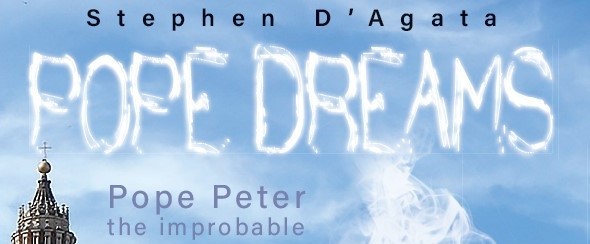
Having established this supernatural premise, the next step was to get rid of the previous Pope. He could die of natural causes, as Popes tend to do. Or the Holy Spirit could bring on his demise by having some recalcitrant doves refuse to be released from his widow during is Sunday address to the faithful at St Peter’s square. This idea came from a real event where Pope Benedict XVI was releasing doves with the assistance of two children, and the doves were refusing to leave the windowsill. In my novel, Pope Dreams – Pope Peter the Improbable, the diminutive Pope Anthony has the same problem. But, in his enthusiasm to encourage the birds into flight, he overextends his torso over the sill and falls to his demise on the stone terrace below.

As well as providing the story concept, I decided to use the dreams as a comedic device and a way to humanise the Cardinals. In the hierarchical structure of the Catholic Church, there is a tendency to treat Bishops and Cardinals as demi-gods. But they are ordinary men with ordinary interests and desires. So, in their dreams, I have them surfing, playing football, singing opera, driving fast cars, doing stand-up comedy, and cycling in the Tour de-France, among other things.
During the time that these ideas were developing, I was working as a Civil Engineer and volunteered as a Pastoral Councillor at small town parish church. My Parish Priest was close to retirement and was concerned that, with declining priest numbers, the parish would not get another priest once he left. His view was, that in this situation, the congregation would have to step up. To prepare us for this, he would not look for another priest to step in when he was away but would have us run weekend services without a priest. Whilst we were more than happy to do this, certain forces within the diocese were not. Our priest was told that if he was unable to hold Sunday services, he must find a suitable priest to hold them for him. His response to that was, that many of the priests who were routinely available to fill in, were not suitable and he didn’t want them anywhere near his parishioners.
It was then that I realised, with some bewilderment, that factional forces in the Church were working to undermine progressive ideas. My bewilderment stemmed from the fact that the hierarchy seemed to be stifling the great pastoral work we were doing. It appeared that they were more concerned about adherence to doctrine than Christian outreach. That country priest became the inspiration for Peter’s friend and mentor, Fr Mick, in the novel.
When work took me back to Melbourne, I again joined the pastoral council in our new parish. It was there that I learnt how entrenched conservative forces were in the church hierarchy and that experience inspired Peter’s predicament at the start of the novel. I’ve discussed this in previous blog posts and the full picture is reflected in the storyline. Which you will already know if you read my novel. If not, READ IT NOW!!!!
Other parts of the story came from life experience. The gory vasectomy stories are probably untrue but are circulating as urban myths. The events of Peter’s vasectomy are based on the experience of an acquaintance who had his done in a small-town hospital and was shocked to discover that everyone involved was someone he knew socially. Cardinal Curiosa’s joke, recalled from his dream, was a joke delivered by a priest I knew during a Sunday service. I don’t know exactly where Georgio, the Jesuit College’s everyman, came from. I just saw him as an Addam’s Family Lurch type character.
So, there it is, that is how a Civil Engineer gets to write a satirical novel on the Catholic Church. Now, all you must do is… READ IT.
 Stephen D'Agata
Leave a comment